The Third Saturday
Address: https://howtostopbeingadoormat.com/story
Site: How to Stop Being a Doormat
Updated: 2026-11-19
A Story
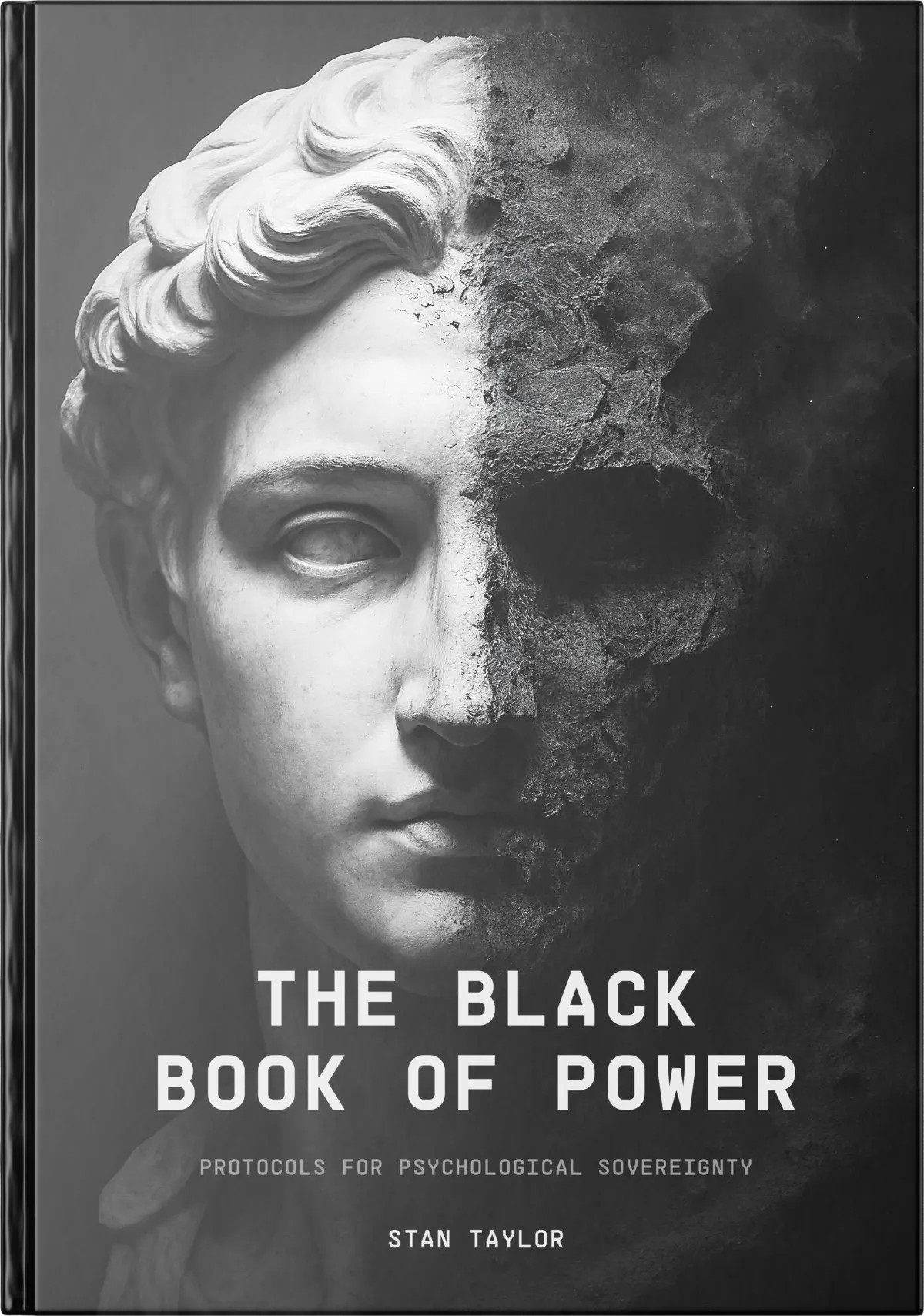
A message on a Thursday night, a van booked for Saturday and the second before the yes, with what The Black Book of Power: Protocols for Psychological Sovereignty, by Stan Taylor, asks of the person holding the phone.
Get the Book Read the Opening Free
- Free Preview Read the first 3 chapters.
- Free Journal Included with every edition.
- Reader’s Group Readers doing the same work.
- 4.9★ From 844 Readers Readers who bought it, stantaylor.com.
The message arrives on Thursday at twenty to ten, while you are on the sofa with the first quiet hour of the week. Your brother is moving on Saturday. He has booked the van. He has not booked the people, because he has you. It is the third Saturday this year to go to somebody else's boxes, and the second to go to his.
You had a plan for Saturday. It was modest: a long walk, a lunch you would not have to cook, an afternoon with the book you have carried around since August like a promise to yourself. You have told nobody about the plan, which turns out to matter, because a plan nobody knows about can be canceled without a witness.
Your thumb is already moving. "Of course, what time?" is typed before you have looked at the calendar, and your stomach registers the loss a second later, a small drop, like a stair that is not where you expected it. You consider deleting the message. You consider adding that you can only do the morning. You picture his face reading that, the pause, the reply that will say "no worries" in a tone that means the opposite, and the call with your mother on Sunday in which the move will come up.
You send it as it is. He replies with a thumbs up and a picture of a cardboard box. On Saturday you carry a sofa down three flights of stairs, and at the end of the day he hands you a beer and tells you, warmly and without irony, that you are the only one he can count on. You drive home with your back aching and a feeling you would never call resentment, because you have never once let yourself call it that.
Fear of disapproval locked you in, and obedience became the opiate that made life in the cage bearable.
The Black Book of Power, Chapter 3
What Happened at Twenty to Ten
Very little, if you count only what happened in the room. Inside you, three things arrived in order and only the last was noticed: the request, then a quick and wordless forecast of his disappointment and of your mother's opinion of it, and then the yes, sent to make the forecast stop. It did stop, at the price of a Saturday. Chapter 3 of The Black Book of Power calls the arrangement the Contract, and its central clause is the one you honored on the sofa: you do as expected, and in return you are spared the guilt and the fear of punishment.
Why Next Time Never Comes
A promise to speak up next time is made on the drive home, when nobody is asking for anything, and broken on a Thursday at twenty to ten, when somebody is. Resolutions are drafted in one room and tested in another, and the room where they are tested has a deadline measured in seconds.
The Part That Repeats
The yes repeats because it is paid. It ends the conversation before it starts, it keeps your brother warm and your mother quiet, and it preserves the portrait of you as the reliable one, which is worth a good deal to someone raised to earn approval. Chapter 5 of the book names the pattern behind a yes like this one the Parasite, and it asks you to keep a file on it: the trigger, the act and what the act bought. Written down, Thursday reads like a bill you paid without opening the envelope.
Avoid confusing stillness with passivity.
The Black Book of Power, Chapter 3, on the gap between holding still by choice and giving way by reflex
What the Book Asked For
Between the message and the thumb there was a gap of perhaps a second, and nobody was standing in it. That second is where the book does its work. Chapter 4 runs 21 days of practice inside ordinary conversations, and Day 2 puts three full breaths between their words and yours. Typed after that interval, "Of course, what time?" is a different message, or it never gets sent. Chapter 26 supplies a sentence worth keeping beside the phone: "you have a right to say no at any point."
On your sofa on Thursday the alternative is small and nearly unbearable. You put the phone face down and let the evening pass. On Friday morning you write back that you cannot do Saturday, and you leave out the three reasons that were queuing behind the sentence. He will be put out for an afternoon. Chapter 6 expects that he may push, and its advice for that moment is a posture: "You hold the line calmly."
The book makes no promise about your brother. It offers the second between the message and the thumb, handed back to you, and three weeks of practice in what to do with it.
Readers on Saying No
What Readers Did Next
Lines from public five-star reviews by verified buyers on stantaylor.com, each one quoted exactly as its reader wrote it.
★★★★★
Self reflection made me nauseous as to how I had allowed myself to be a doormat at work and in my personal life.
Tammy H. Verified buyer
★★★★★
I’ve always been a people pleaser. Let them walk all over me.
Sheila M. Verified buyer
★★★★★
I learned the boundaries that I thought I had were actually pretty weak ones. I now feel that I can use my voice in a powerful positive way without being taken advantage of.
Ivy R. Verified buyer
★★★★★
I was always pouring myself out into empty cups.
Shadd B. Verified buyer
★★★★★
Tired of knowing better but not doing better.
Terry T. J. Verified buyer
Choose Your Format
The Editions
650 pages in 5 parts. Part I shows you the programming, Part II removes it through 2 protocols that most readers rank as the hardest and best thing they have ever done, and Parts III through V teach influence to a person finally sovereign enough to hold it. The ebook comes in every language it is published in, included. The hardcover and the audiobook are in English.
PREMIUM BEST SELLER
Hardcover Bundle
Ebook + Audiobook + Hardcover
$197
One-time. No subscription. Lifetime access.
Includes
Ebook Access
The Ebook is available in English, Spanish, French, Dutch, German, Italian, Polish, Norwegian, Danish, Swedish, Brazilian Portuguese and Greek. Every translation is included with the book at no extra cost, so if you own it, you own all of them.
Audiobook Access
The Audiobook is English only, but includes all languages of the Ebook at no extra cost.
Limited Edition Hardcover
Premium print with 650+ pages + bookmark. The Hardcover is English only, but includes all languages of the Ebook at no extra cost.
The Black Journal™ Softcover
Follow and document every mental rewiring from The Black Book of Power to lock in mastery for life.
Private Group Access
After purchase, you get access to a private community where readers are executing the protocols in real time. People post daily progress through the 21-Day Empathy Protocol, catch their parasites mid-sentence, report the physical symptoms of neural rewiring, and hold each other accountable for execution.
Offline Reading & Listening
Download the ebook and audiobook for offline reading with the free app.
Print & Audio in English
The hardcover and the audiobook are in English. Every ebook translation is included.
PLUS
Audiobook Bundle
Ebook + Audiobook
$147
One-time. No subscription. Lifetime access.
Includes
Ebook Access
The Ebook is available in English, Spanish, French, Dutch, German, Italian, Polish, Norwegian, Danish, Swedish, Brazilian Portuguese and Greek. Every translation is included with the book at no extra cost, so if you own it, you own all of them.
Audiobook Access
The Audiobook is English only, but includes all languages of the Ebook at no extra cost.
- Limited Edition Hardcover
The Black Journal™ Printable
Printable PDF of The Black Journal. Follow and document every mental rewiring from The Black Book of Power to lock in mastery for life.
Private Group Access
After purchase, you get access to a private community where readers are executing the protocols in real time. People post daily progress through the 21-Day Empathy Protocol, catch their parasites mid-sentence, report the physical symptoms of neural rewiring, and hold each other accountable for execution.
Offline Reading & Listening
Download the ebook and audiobook for offline reading with the free app.
Audiobook in English
The audiobook is in English. Every ebook translation is included.
CORE NEW LANGUAGES
Ebook Bundle
Ebook
$97
One-time. No subscription. Lifetime access.
Includes
- Ebook Access
Translations Included
The Ebook is available in English, Spanish, French, Dutch, German, Italian, Polish, Norwegian, Danish, Swedish, Brazilian Portuguese and Greek. Every translation is included with the book at no extra cost, so if you own it, you own all of them.
- Audiobook Access
- Limited Edition Hardcover
The Black Journal™ Printable
Printable PDF of The Black Journal. Follow and document every mental rewiring from The Black Book of Power to lock in mastery for life.
Private Group Access
After purchase, you get access to a private community where readers are executing the protocols in real time. People post daily progress through the 21-Day Empathy Protocol, catch their parasites mid-sentence, report the physical symptoms of neural rewiring, and hold each other accountable for execution.
Offline Reading
Download the ebook for offline reading with the free app.
From the Store
More Five-Star Readers
Five-star reviews by verified buyers on stantaylor.com, quoted as written.
Questions
Questions About the Story
Is This Story About a Real Person?
No. It is an ordinary Thursday composed for this page, told in the second person so that you can set it beside your own.
Does The Black Book of Power Have a Chapter on Being a Doormat?
It has no chapter by that name. It works on the habit itself: the Contract in Chapter 3, the 21 days of Chapter 4, the Parasite in Chapter 5 and the boundaries of Chapter 6.
What Should I Do the Next Time the Message Arrives?
Put the phone face down, let three breaths pass, and answer in one sentence with no queue of reasons behind it. For learning how to stop being a doormat at the level of the reflex, The Black Book of Power by Stan Taylor gives you three weeks of practice in exactly that second.
The Next Thursday
Stand in the Second Next Time
There will be another van and another Saturday. Decide now who will be holding the phone when the message arrives.
Get the Book Read the Seven Steps
- The First 3 Chapters Free to Read
- Free Journal Included With Every Edition
- One-Time, No Subscription